
The short answer
If your furnace blows cold air, cycles on and off, makes new noises, or won't start, schedule a repair visit before small problems turn into bigger ones. We diagnose the cause, explain your repair and replacement options in plain terms, and get your approval before doing any work.
San Jose winters are mild compared with most of the country, but the Santa Clara Valley's damp winter nights still get cold enough that you notice when the heat stops working. Because many South Bay furnaces sit unused for months and then run hard for a few weeks, problems often appear on the first chilly evening of the season. RapidBreeze HVAC Repair Service diagnoses and repairs gas furnaces for homeowners in San Jose and the surrounding area. This page covers the signs that your furnace needs attention, what our technicians check, how to weigh repair against replacement under current Bay Area rules, what affects the cost of a repair, and what happens during a service visit.
Signs Your Furnace Needs Repair
Most furnace problems give some warning before the system stops completely. If you notice any of the following, it's worth having the furnace looked at, especially before the coldest weeks of winter.
If you smell gas, leave the house right away and call your gas utility or 911 from outside. Don't flip switches or try to relight anything. Furnace repair can wait until the gas supply is confirmed safe. A carbon monoxide alarm going off also calls for getting everyone outside first.
- The blower runs but the air coming from the vents is cool or lukewarm
- The furnace turns on and off in short bursts instead of running full cycles
- Some rooms stay noticeably colder than others
- New noises such as banging at startup, squealing, scraping, or rattling
- The furnace won't ignite, or the igniter clicks repeatedly without lighting
- A burning or dusty smell that keeps going after the first few minutes of the season
- The thermostat calls for heat but nothing happens
- Error lights blinking on the furnace control board
- Heating bills climbing without a change in how you use the system
What We Check During a Furnace Repair
A good repair starts with finding the actual cause, not just the obvious symptom. A furnace that short-cycles, for example, might have a dirty flame sensor, a clogged filter causing overheating, or a thermostat problem. Our technicians work through the system step by step so the fix addresses what's really wrong.
Along with whatever prompted your call, we look at the furnace's safety components. If we find a cracked heat exchanger, a venting problem, or anything else that could let combustion gases into your home, we'll explain it clearly and recommend shutting the furnace off until it's resolved.
- Thermostat settings, wiring, and communication with the furnace
- Air filter condition and airflow through the system
- Ignition system, including the hot surface igniter or pilot assembly
- Flame sensor, burners, and gas valve operation
- Blower motor, capacitor, belt (on older units), and wheel
- Limit switches, pressure switches, and other safety controls
- Inducer motor and venting for proper draft
- Heat exchanger condition, as visible during inspection
- Control board error codes and electrical connections
- Condensate drain and pump on high-efficiency furnaces
Repair or Replace: How to Decide
Many furnace problems come down to a single worn part, such as an igniter, flame sensor, capacitor, or switch, and repairing it is usually the sensible choice. Replacement becomes worth discussing when the furnace is older and needs a major component, when repairs are becoming frequent, when the heat exchanger is cracked, or when the system can't keep your home comfortable even when it's working correctly.
Bay Area homeowners should also know about the region's air quality rules. Under Bay Area Air District Rule 9-4, natural gas furnaces manufactured from 2029 onward must meet a zero-NOx emission standard. In practice, this points homeowners toward heat pumps when a furnace is replaced after that date. The rules do not require you to replace a furnace that's working. They apply only when existing equipment fails or is replaced, so repairing your current furnace remains an option.
If you're weighing a heat pump, keep in mind that the federal Energy Efficient Home Improvement Credit (25C) only covered qualifying heat pumps placed in service before December 31, 2025. It isn't available for new installations after that date. Bay Area homeowners can still check BayREN and their local clean energy provider for heat pump and electrification incentives. Because amounts and availability change by funding cycle, we confirm the current offer before including it in any quote.
Our role is to lay out the options honestly. If a repair makes sense, we'll say so. If replacement is worth considering, we'll explain why and leave the decision to you.
What Affects the Cost of a Furnace Repair
Every furnace and every problem is different, so we give you a specific quote after diagnosing the system rather than guessing over the phone. These are the main factors that shape the cost:
- The part that failed, since a flame sensor or igniter is a simpler fix than a blower motor, inducer, or control board
- Whether parts are universal or brand-specific, and how readily available they are
- The furnace's type and age, including standard versus high-efficiency condensing models
- Where the furnace is installed, since attics, crawlspaces, and tight closets take more time to work in
- Whether more than one issue is found, such as a failed part plus a clogged drain or dirty burners
- Timing, since urgent same-day or after-hours visits can differ from scheduled appointments
How a Furnace Repair Visit Works
When you contact us, we'll ask what the furnace is doing, how old it is if you know, and where it's installed. That helps the technician arrive prepared. We'll give you an arrival window and let you know if anything changes.
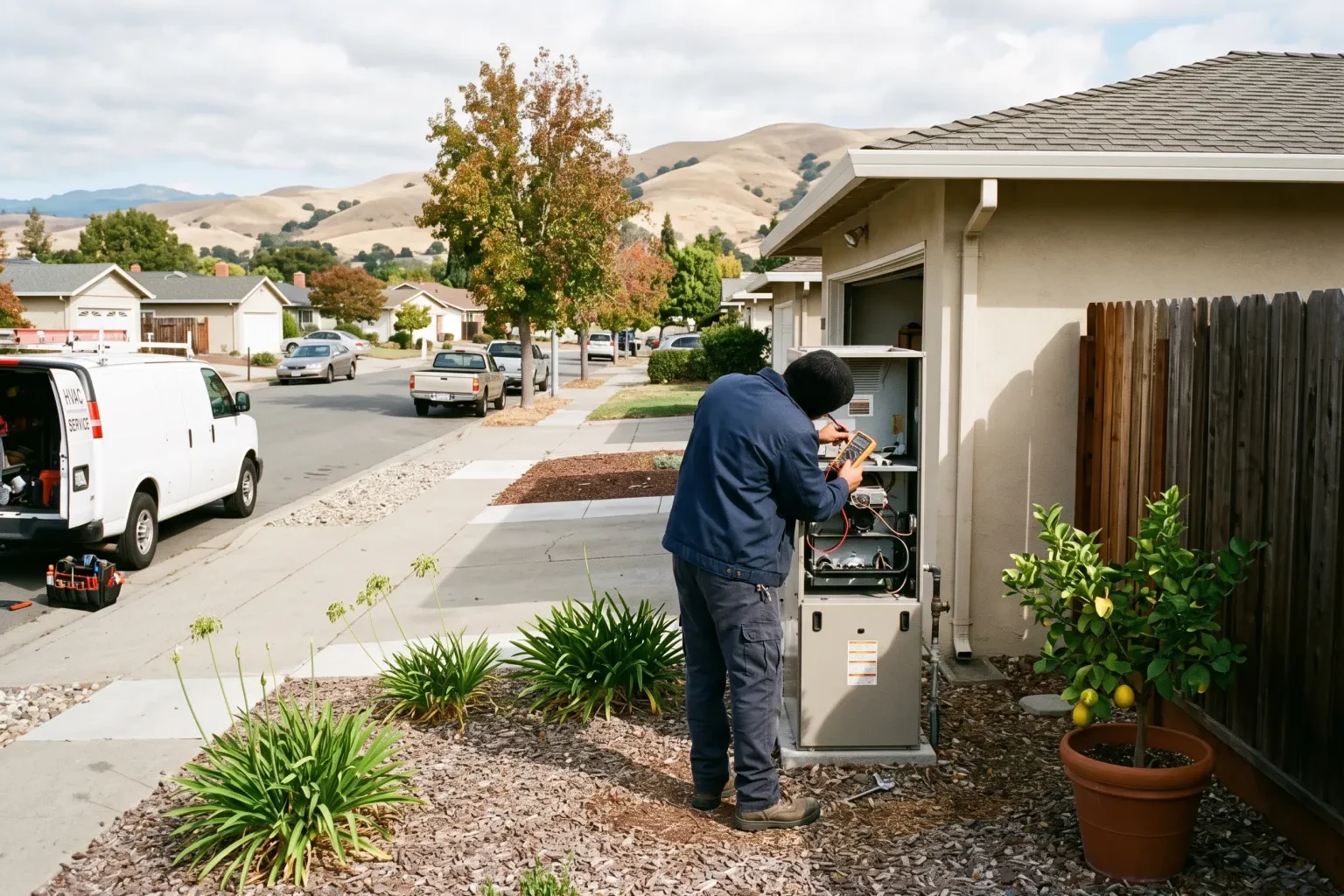
At your home, the technician will listen to your description of the problem, check the thermostat, and then inspect and test the furnace. Once the cause is found, we explain what's wrong, show you the failed part when possible, and give you a clear quote. No repair work starts without your approval.
Many common repairs can be completed during the same visit. If a specific part needs to be ordered, we'll tell you how long it should take and whether the furnace can run safely in the meantime. After the repair, we run the furnace through full heating cycles to confirm it's working correctly, then walk you through what we did and any maintenance we'd suggest, such as changing filters regularly or scheduling a fall tune-up before heating season.
Furnace Repair by city
- Furnace Repair in Santa ClaraLocal service & repairs
- Furnace Repair in CampbellLocal service & repairs
- Furnace Repair in SunnyvaleLocal service & repairs
- Furnace Repair in CupertinoLocal service & repairs
- Furnace Repair in MilpitasLocal service & repairs
- Furnace Repair in SaratogaLocal service & repairs
- Furnace Repair in Monte SerenoLocal service & repairs
- Furnace Repair in Los GatosLocal service & repairs
- Furnace Repair in Mountain ViewLocal service & repairs
- Furnace Repair in Los AltosLocal service & repairs
- Furnace Repair in FremontLocal service & repairs
- Furnace Repair in Los Altos HillsLocal service & repairs